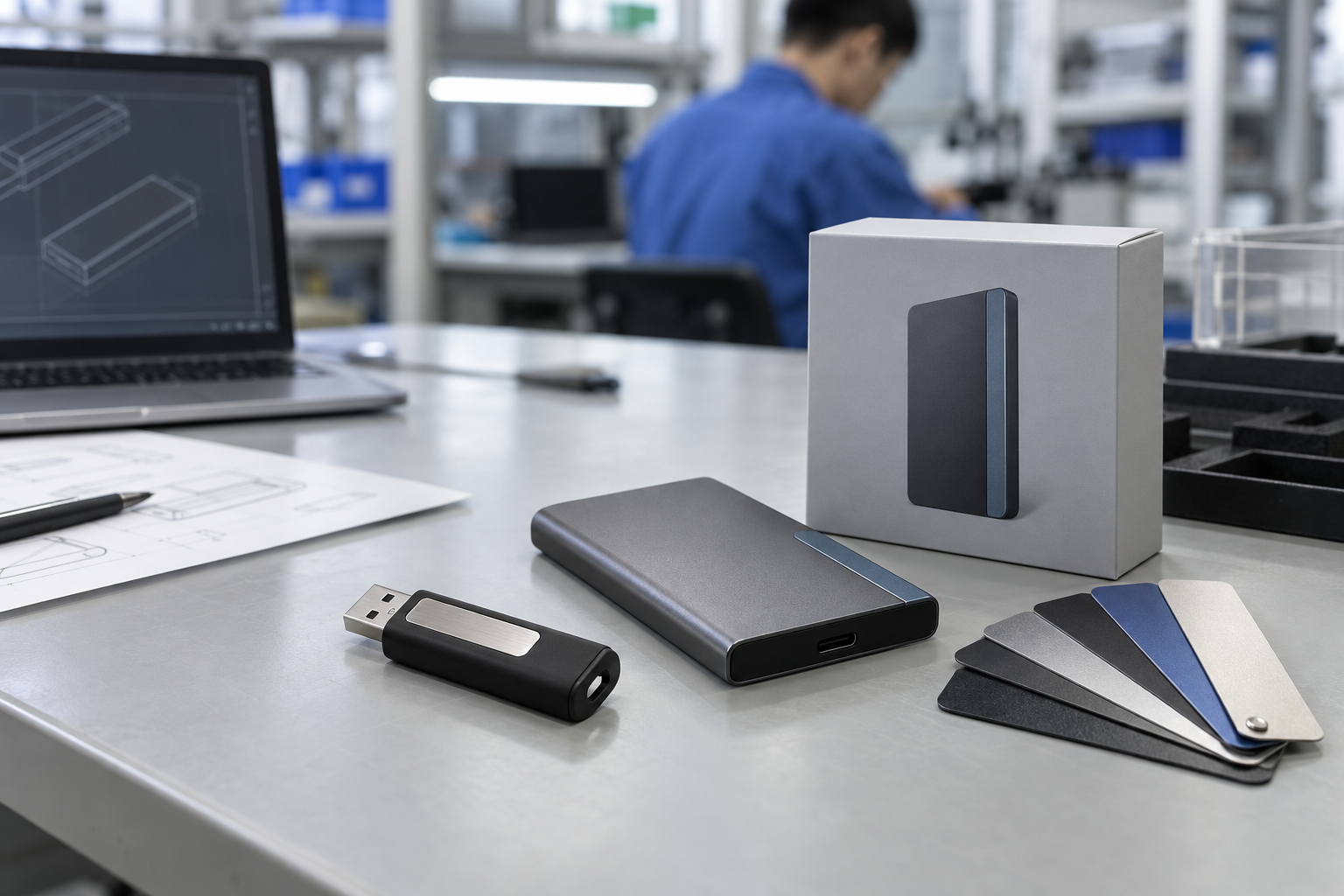
Quick answer: The best custom USB drive for a corporate gift is the one that matches the recipient’s devices, the content being delivered, and the brand experience the buyer wants to create. Before ordering logo USB drives in bulk, define capacity, connector, shell style, branding method, data preload, packaging, delivery date, and inspection criteria. A physical sample should confirm both the product and the presentation before volume production starts.
Introduction
Custom USB drives for corporate gifts are small products with a large number of decisions behind them. They can be handed out at a trade show, placed in a training kit, sent to a client with a project archive, included in an employee onboarding pack, or sold as part of a branded merchandise program. The use case may be simple, but the buyer still needs to control the recipient experience: whether the drive fits the available ports, whether the logo is legible, whether the supplied files are correct, and whether the final package arrives in time.
The strongest programs do not begin by choosing the most unusual shape. They begin by asking what the recipient will do with the drive. Will it hold a 500 MB catalog? A collection of product videos? An installation package? A small thank-you message and a voucher? Will the user connect it to a current USB-C laptop, an older desktop with USB-A, or both? Once those answers are clear, creative choices become easier and operational risks become visible early.
This guide is for distributors, marketing agencies, private-label brands, event organizers, and procurement teams. It incorporates six useful search terms naturally: custom usb drives for corporate gifts, logo usb drives bulk, promotional usb drives bulk, custom usb drive packaging, preloaded usb flash drives bulk, and usb flash drive custom branding. The goal is to help B2B buyers create an approval-ready order, not to promise that one USB model fits every campaign.
Start With the Gift Program, Not the USB Shell
Define the recipient and the moment of use
Write one sentence describing the program. For example: “A compact branded USB drive carrying an approved product presentation for 800 distributor attendees, packed in a navy gift box, delivered before a regional sales meeting.” That sentence creates a decision framework: the files must open, the capacity must fit with margin, the design must feel appropriate for the audience, and the packaging must be ready for event distribution.
Different recipients value different features. A key-ring drive may be practical for a broad event audience. A metal model in a gift box may suit a partner appreciation program. A dual-interface model can reduce friction in a mixed USB-A and USB-C device base. A customer who will receive a large media folder may need a different product choice from a recipient receiving a few PDFs.
Set the capacity around the actual content
Ask the content owner for the final or estimated file set early. Include videos, PDFs, installers, multilingual versions, and any required working room. If the drive will be preloaded, decide whether recipients should have free space available after they receive it. Capacity should be practical for the content and the commercial program—not selected only because a larger number sounds more impressive.
Confirm the file system and target devices before the preload stage. If users need to access files on both Windows and macOS, include that in the brief. A small sample with the real file set is one of the best ways to identify an issue before an event or campaign date is close.
Choose connector strategy from the installed base
USB-A is still relevant in many business desktop and laptop environments. USB-C is common on newer hardware, and dual-interface designs can serve mixed fleets. The connector shape should be visible in the RFQ and sample request; do not assume that a modern-looking connection is automatically the most practical choice for every recipient.
USB-IF publishes standards resources, but a campaign buyer does not need to interpret specifications alone. The practical action is to list the devices being supported and ask for a sample to be checked with representative hosts. This turns compatibility into a real test rather than a line of promotional copy.
Choosing a Product Style for Promotional USB Drives Bulk Orders
Classic, metal, wood, card, and custom-shape designs
The physical style should support the campaign message and the expected handling. A classic compact body works for broad distribution. Metal can create a more premium impression. Wood may support a natural or craft-oriented brand story. Card designs offer a large printable surface. Custom-shaped products can be memorable, but they normally require more time for design review, sampling, and sometimes tooling.
Choose a style that can be approved and delivered confidently within the campaign calendar. A complicated form may not be a good choice when the event date is fixed and the marketing team has not finalized its artwork. A standard shell with strong branding, a quality insert, and useful preloaded content can produce a more reliable outcome than an elaborate product rushed through approval.
Logo method and artwork preparation
Logo USB drives bulk projects commonly involve print, laser marking, or another method appropriate to the selected shell. The supplier should explain the usable logo area, artwork format, color limits, and any minimum line-weight concerns. Provide vector artwork where possible and request a digital placement proof before sampling.
A digital proof is important, but it is not the final approval. A physical sample reveals details that a screen cannot: contrast against the material, alignment, texture, cap fit, key-ring hardware, and how the finished object feels in hand. Keep the approved sample and artwork file together with the purchase order so they remain the reference for production and repeats.
Packaging is part of the gift
Custom USB drive packaging influences protection, presentation, distribution speed, and the brand message. A simple polybag may suit a high-volume handout. A branded box and insert may suit a client gift. A retail program may need a barcode, product label, multilingual copy, and master-carton mark. Clarify which packaging layer is required before comparing quotations.
Include the following in the pack-out brief: inner-pack count, box dimensions, insert content, outer carton quantity, carton labels, barcode responsibility, and destination-specific requirements. A drive can be technically correct and still disappoint the customer if the pack-out feels unfinished or makes event distribution difficult.
Preloaded USB Flash Drives Bulk: A Controlled Content Process
Preload can turn a USB drive into a complete information kit. It can carry a catalog, sales presentation, training library, launch media, software, portfolio, or customer welcome message. It can also create risk if files are late, incomplete, corrupted, or from the wrong version.
Agree the final content package
Set a file handoff date and name one responsible customer contact. The buyer should provide final, virus-scanned files with a clear folder structure. Define whether files should be read-only, whether the drive should have a particular label, and whether recipients are expected to add their own files. If a version manifest or checksum process is appropriate for the project, agree it before the files are transferred.
Approve a preloaded sample
Check the contents on the target systems, not only on one office computer. Open the key documents, videos, and installers. Verify the folder names, language versions, and expected available space. Record the exact files approved. This sample is the simplest way to make the data-preload requirement concrete.
Include preload in shipment inspection
For a preloaded USB flash drives bulk order, capacity verification alone is not enough. The inspection plan should include a suitable sample of drives checked against the approved file list. The correct sampling method depends on the project agreement, but the principle is stable: inspect the contents that the customer will receive, not just the hardware body.
Mid-article CTA — Turn your campaign into a sample-ready USB brief. Send StorFlux your audience, files, capacity range, device mix, artwork, packaging direction, quantity, and event date. We will help organize the product and approval steps. Send Your Requirements.
Build a Timeline Backward From the Event or Delivery Date
Promotional programs often fail because “factory lead time” is treated as the complete schedule. A realistic plan also includes artwork preparation, proof review, sample production, sample delivery, approval, preload finalization, volume production, shipment inspection, freight booking, transit, and receiving time.
Work backward from the required arrival date. Identify dates for the final artwork, final files, sample approval, inspection, and shipping decision. If a deadline is non-negotiable, use a product style and packaging approach that can be approved inside the available window. Do not allow a complex custom-shaped request and an unfinished content package to share the same final week.
The purpose is not to make the program slow; it is to make it predictable. Clear milestones also help a buyer compare suppliers: an accurate milestone plan is more valuable than a short production claim that excludes the work needed before and after the production line.
Factory Testing and Shipment Inspection for Branded USB Gifts
The test method should match the project. A general event giveaway, a branded client archive, and a preloaded software handover may have different risk profiles. Whatever the scope, define it before volume production begins.
Product and functional checks
Ask the supplier to explain the planned checks for the proposed configuration. These may include visual inspection, connector function, capacity or storage access, marking, and the condition of accessories or caps. A useful plan states what is checked and how nonconforming units are handled; it does not rely on a generic phrase such as “all quality guaranteed.”
Branding and packaging checks
Compare the logo, color, print position, box, insert, barcode, and carton mark with the approved sample or visual reference. Check a random finished pack, not only loose drives. This is important because the recipient sees the whole gift, not an isolated component.
Data-preload checks
When files are part of the program, include the approved content manifest in the inspection reference. Confirm that sampled units contain the correct folders and that important files open. For sensitive content, agree a controlled handling process with the buyer rather than sending files through informal channels.
StorFlux can help buyers frame a project-specific quality conversation through our quality page. You can also see the relevant production and shipment environment on the factory page.
Common Mistakes in Corporate USB Gift Programs
Choosing capacity before content is known
Ask for the actual content estimate first. A small file package does not need an excessive capacity, while an unexpected video library may need more than the initial plan allowed. Keep room for the final version and the recipient’s likely use.
Forgetting the recipient’s ports
A USB device is only useful when it connects easily to the intended hardware. List the device types, consider USB-A, USB-C, or dual-interface needs, and check a physical sample with representative systems.
Treating artwork proof as final approval
Approve a physical sample for new designs, logo methods, and packaging. It is the stage where size, finish, color, handling, and presentation become real.
Sending late or unversioned preload files
Name an owner, set a file deadline, preserve folder names, and approve the final content package. Last-minute content changes can be accommodated only when the project calendar allows for them.
Leaving inspection until after the shipment is booked
Agree what will be checked and when. An inspection plan is a release process, not an emergency reaction when cartons are already at a forwarder.
FAQ
What information is needed to quote custom USB drives for corporate gifts?
Share the audience and application, estimated quantity, capacity, connector preference, preferred shell, artwork, packaging, preload requirement, destination, and required arrival date. A good brief also describes the target devices and any inspection expectation.
Can promotional USB drives bulk orders include preloaded videos and PDFs?
Yes. Define the final file set, folder structure, file-system requirement, handoff method, and a sample approval process. Include content verification in the shipment-inspection plan when the files are part of the customer experience.
What is the best USB connector for a corporate gift?
The best option depends on the recipients’ actual devices. USB-A supports many existing desktops and laptops; USB-C suits newer systems; dual-interface designs can help mixed device groups. Test the proposed item with representative hardware before volume production.
How do I approve custom USB drive packaging?
Approve the finished pack, including the drive, logo, insert, box, barcode, and any outer label. Keep the physical sample, artwork, and packaging proof as the production reference for inspection and repeat orders.
How far ahead should a corporate USB gift program be planned?
Plan backward from the required arrival date and include artwork, sample approval, preload, production, inspection, freight, and receiving. The exact time depends on the product and destination, but a defined milestone plan is safer than relying on a factory-only lead-time statement.
Conclusion
Custom USB drives can be effective corporate gifts because they combine a physical branded object with useful information or storage. The result is strongest when it is planned as a complete B2B program: recipient devices, content, capacity, connector, design, packaging, sample approval, testing, and delivery all need a clear role.
StorFlux can help you turn an early gift concept into a controlled product brief for a branded USB drive, data preload, packaging, and shipment release. Start with the way recipients will use the product, then build a sample and inspection path around it.
Final CTA — Create a USB gift your recipients can actually use. Tell StorFlux about the campaign, files, device mix, branding, packaging, and delivery target. Get a Quote or explore our OEM & ODM process.
Sources and related StorFlux pages
Discuss your storage requirement
Send StorFlux the intended use, capacity, platform or device list, branding direction, quantity, and delivery target. We will help you convert it into a sample-ready B2B brief.
Get a Quote