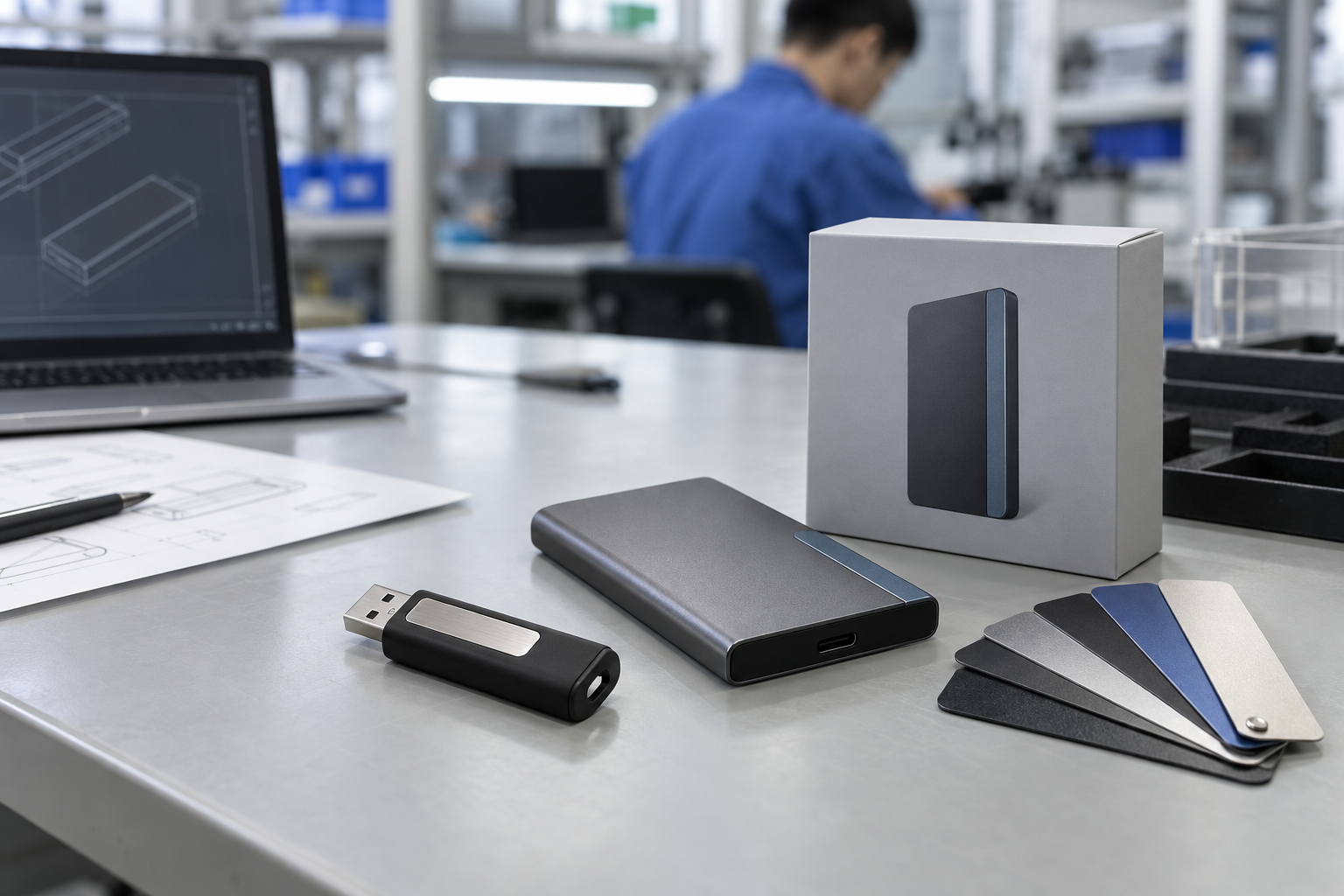
Quick answer: A credible OEM USB flash-drive supplier should be able to turn your application, artwork, capacity, connector, preload, packaging, and delivery needs into a written sample and inspection plan. Compare suppliers on specification control and evidence—not only quoted price. Before placing a bulk order, approve a physical sample, define how capacity and function will be checked, and make shipment release criteria part of the purchase order.
Introduction
Buying custom USB flash drives for a promotion, reseller program, client onboarding kit, or private-label product line is not the same as buying a generic accessory. The drive may carry your brand, preloaded content, or a customer’s important files. If it arrives with the wrong connector, a weak logo contrast, incorrect content, damaged packaging, or an unverified capacity, the cost is more than a replacement unit. It can delay a campaign and weaken trust in the buyer’s brand.
The most dependable procurement process starts before a supplier sends a price. It begins with a clear application brief and a supplier discussion that covers what will be delivered, how it will be sampled, and how both sides will know that bulk production matches the approved sample. This is especially important when a request includes custom shapes, multiple regional packaging versions, data preload, or a tight event date.
StorFlux is based in Shenzhen with an 8,000 m² factory facility for storage-product projects. This article turns the questions our B2B buyers should ask into a reusable evaluation framework. It is intentionally practical: no supplier should ask you to accept vague claims instead of a clear specification, physical sample, and documented inspection path.
What Does an OEM USB Flash Drive Supplier Actually Need From a Buyer?
An OEM supplier needs more than a logo and quantity. The useful brief identifies who will use the drive, which devices they have, what files they need, how the item should look, how it will be packaged, and when it must arrive. A buyer that supplies this information receives a more comparable quotation and a more meaningful sample.
The core inputs are: capacity; USB-A, USB-C, or dual-interface requirement; preferred shell or material; logo method; color reference; artwork files; data preload; packaging; destination market; quantity; target date; and inspection expectations. If any item is undecided, label it as a decision point rather than allowing a supplier to make a silent assumption.
The 12 Questions to Ask an OEM USB Flash Drive Supplier
1. Can you restate our application and proposed configuration in writing?
Start with comprehension. Ask the supplier to restate the end use, capacity, connector, shell, logo method, packaging, preload, quantity, and target date. This tests whether the quotation is based on your actual customer requirements or on a generic item. The written confirmation should become the basis for the sample request and purchase order.
2. Which connector and form factor fit our recipients’ devices?
USB-A, USB-C, and dual-interface drives solve different compatibility problems. The selection should follow the devices in the program, not the supplier’s newest-looking model. If recipients use a mix of older desktops and new USB-C laptops, dual-interface designs may reduce friction. If the device is a premium giveaway, connector protection, key-ring usability, and logo area may be just as important as appearance.
Remember that a USB-C shape does not guarantee a certain speed or host capability. USB-IF publishes specifications and resources that help buyers understand why the full device-and-host chain must be defined. Use that information to ask precise questions, then have the proposed configuration tested with representative hosts. USB-IF is an appropriate primary reference.
3. What capacity and file-system approach are you quoting?
Ask the supplier to specify the nominal capacity, the planned file system, and any preload assumptions. Capacity must fit the real content with working room, not only an estimated file total. If the device will be used across Windows and macOS, file-system compatibility needs to be decided in the sample stage. If the drive will ship with videos, software installers, or files that may exceed an individual-file limit, that is another reason to confirm the format before production.
Do not ask a supplier to promise a capacity based only on a screenshot. Request a sample that is checked with the agreed method and contains the intended files where a preload is part of the project.
4. What component and configuration control will apply to repeat orders?
For a private-label or repeat program, a buyer needs to know which parts of the configuration are controlled: memory grade or sourcing policy, controller configuration, PCB or shell, connector, logo process, firmware, and packaging. The supplier does not need to disclose confidential commercial details, but it should clearly explain how the approved configuration is preserved and how substitutions are handled.
The key question is simple: will the item approved in sampling be the reference for future production, and will the supplier flag a material change before shipping? A stable answer protects both the brand and the supplier from avoidable disputes.
5. How will our logo, colors, and artwork be approved?
Artwork approval should have three layers: the print-ready artwork file, a digital layout showing placement and scale, and a physical pre-production sample. Ask which logo methods are available—such as screen print, pad print, laser marking, or other appropriate processes—and which one suits the shell material and detail level. Then check the actual logo under normal handling conditions, not only under studio lighting.
For color-sensitive programs, provide a defined color reference and keep photos of the approved sample with the order record. This does not replace a physical standard, but it helps operations teams compare repeat lots and communicate clearly.
6. Can you handle data preload, and how is it verified?
Data preload can be valuable for training kits, catalogs, event content, and product-launch packages. It also creates a separate quality risk because correct hardware can still leave the factory with the wrong file version. Define the file source, folder structure, naming rules, file-system format, version date, and verification method. If files are confidential, agree on a controlled transfer and deletion process separately.
The safest project flow is: customer sends a final, virus-scanned file image; supplier confirms a checksum or manifest where practical; a sample device is approved; and production sampling checks accessibility and folder structure. Do not allow “preload included” to remain an undefined line on a quotation.
7. What factory testing is performed, and what evidence can we review?
This question should produce a test description, not a marketing sentence. Ask which checks apply to the proposed configuration: functional connector checks, capacity verification, read/write checks, visual inspection, preload verification, label checks, and packaging checks. Ask whether checks are 100% or sample-based, how exceptions are isolated, and which records can be shared with the buyer.
The correct method depends on product use and commercial agreement. A low-risk event giveaway and a private-label retail program can require different evidence. What matters is that the method is agreed in advance and can be repeated. Learn more about the StorFlux quality approach before setting your own checklist.
8. How will the physical sample differ from production?
Samples can be made through methods that are not identical to full production. That is normal, but the supplier should explain what the sample confirms and what remains subject to production tooling, material availability, or artwork finalization. A buyer should not infer that any hand-built sample guarantees every final detail.
Ask for a pre-production sample when the design, color, packaging, or preload is important. It should be the final agreement point before volume production: a tangible reference for product, branding, content, and pack-out.
9. What is the lead-time path, including approvals and shipping?
“Lead time” is often misunderstood because it may exclude artwork approval, sample delivery, content finalization, inspection, and transit. Request a milestone plan: quotation, artwork proof, sample, approval, production, inspection, booking, dispatch, and estimated arrival. Your required date should be calculated backward from the event, launch, or retail booking—not from a factory completion date.
For seasonal programs, add contingency time for revisions and freight disruption. A realistic schedule is more valuable than the shortest headline promise. If a deadline cannot move, simplify the elements most likely to cause iteration, such as a highly complex custom shell or late-changing preload content.
10. What packaging and labeling details will be controlled?
Packaging protects the product and delivers the brand experience. It may also carry barcodes, SKU labels, legal marks, multilingual copy, retailer carton marks, or country-specific information. Include inner-pack count, carton quantity, carton dimensions, labeling, insert content, and barcode responsibility in the specification.
Use an approved packaging sample or visual pack-out sheet. During shipment inspection, compare a random set of finished goods to this reference, not simply to an unbranded shell. This is where small errors can become expensive across a full shipment.
11. Can you support an independent shipment inspection?
A capable supplier should accept a reasonable inspection process that has been agreed in advance. If you use an internal quality team or third-party inspector, share the inspection checklist and timing early. Define whether an inspection occurs before final payment or dispatch, how rework is handled, and which version of the sample is the reference.
An inspection normally checks quantities, cosmetic condition, functional samples, approved logo and labels, data preload if applicable, packaging, and cartons. The specific sampling plan should match risk; do not copy an unrelated AQL template without considering the product and program. The aim is a mutually understood shipment-release decision.
12. Who owns communication if a requirement changes?
Projects change: a customer may revise a logo, add a language, change the destination, or update a preload file. Establish one accountable buyer contact and one supplier contact. Require written change approval for any change affecting specification, artwork, price, timing, or inspection. This prevents an informal message from becoming an untracked factory instruction.
A Supplier Scorecard That Produces Better Comparisons
Price matters, but a useful supplier comparison puts it alongside risk controls. Score each candidate from 1 to 5 across the categories below, and record the evidence used—not just an impression from a sales call.
| Evaluation area | Evidence to request | Why it matters |
|---|---|---|
| Requirement understanding | Written configuration recap | Reduces wrong-product quotations |
| Sample control | Artwork proof and physical sample plan | Confirms visual and functional expectations |
| Technical fit | Connector, capacity, file-system discussion | Prevents end-user compatibility problems |
| Preload process | File handoff and verification plan | Protects content accuracy |
| Quality process | Clear factory-testing and exception process | Makes inspection meaningful |
| Packaging control | Approved pack-out specification | Reduces retail and event delivery errors |
| Schedule clarity | Milestones from sample to dispatch | Helps protect launch dates |
| Communication | Named contacts and change-control method | Limits misunderstandings during execution |
The scorecard should not be used to create a fictional sense of precision. It simply makes a buyer compare the same questions across suppliers. A lower quote may still be the right choice, but the decision will be deliberate rather than accidental.
Mid-article CTA — Want an RFQ that suppliers can quote accurately? Share your application, quantity, device mix, artwork status, packaging, and deadline. StorFlux will return a configuration checklist for a custom USB-drive sample. Send Your Requirements.
From RFQ to Shipment: A Reliable Project Sequence
Stage 1: Build the customer-requirements brief
State the use case in one sentence, then add technical and brand details. For example: “A dual-interface USB flash drive for a distributor’s 1,000-person product-training program, preloaded with a final video-and-PDF folder, packaged in a branded gift box, for delivery in Germany before a fixed event date.” This brief tells a supplier what needs special attention.
Stage 2: Review a comparable quotation
Ask each supplier to quote the same capacity, connector, logo method, packaging, preload, delivery term, and quality expectation. A cheaper quotation that omits packaging or data handling is not directly comparable. Clarify what is included before comparing unit prices.
Stage 3: Approve artwork and a physical sample
Check functionality, connector fit, logo position, color, packaging, data files, user instructions, and barcode details. If the sample is for a custom shape, check handling and structural details. Record approvals in writing and retain photos or the physical approved sample.
Stage 4: Freeze the production specification
Issue a purchase order that attaches the approved artwork, technical specification, packaging details, content manifest, quantity, schedule, and inspection standard. This turns a sales conversation into an operational document.
Stage 5: Verify before shipment
Use the agreed factory-testing and shipment-inspection process. Review the result against the sample and PO. If an issue appears, decide whether it is a cosmetic variance, a functional issue, a packaging error, or a content error; each needs a different correction path.
For more detail on design, data preload, packaging, and private-label decisions, visit StorFlux OEM & ODM. If a heavier transfer workload is involved, compare USB flash drives and portable SSDs before setting the product brief.
Common Warning Signs During Supplier Selection
Vague answers about test methods
“Everything is tested” does not define which function is checked, what the acceptance criteria are, or how failures are contained. Ask for the actual test scope and how it relates to your use case.
A quote that does not mention your artwork or packaging
When the quotation ignores the branded elements that make the project unique, it may be based on assumptions. Ask for a revised configuration recap before approving any payment or sample.
Pressure to skip the sample stage for a custom program
Skipping samples can be reasonable only for a repeat order with a known and retained reference. For a new branded product, custom packaging, or data preload, a physical sample is the least expensive place to catch errors.
An unrealistic schedule with no milestone detail
A short factory number is not a full arrival plan. Ask when artwork, content, inspection, booking, and delivery are included. Clear schedules are a sign of process discipline, not slower service.
FAQ
What is the minimum information an OEM USB drive supplier needs for a quotation?
Provide the use case, quantity, capacity, connector preference, desired shell or model, logo artwork, packaging needs, destination, target arrival date, and whether you need data preload. If something is undecided, identify it as an open choice so the supplier can quote alternatives rather than assume.
Is a pre-production sample necessary for a custom USB flash-drive order?
It is strongly recommended for a new branded program, especially when colors, printing, packaging, or preload content matter. The sample confirms the product’s appearance and functional fit before bulk production. For repeats, retain the approved reference and reconfirm any changed details.
How can I verify USB flash-drive capacity before shipment?
Agree a capacity-verification method with the supplier and include it in the inspection plan. A buyer may request functional sampling, capacity checks, and verification of any preloaded content. The exact test and sample size should be appropriate to the order’s risk and use case.
Can an OEM supplier make custom packaging and preloaded content together?
Yes, but both need separate control. Approve the packaging layout, labels, inserts, and pack-out; separately approve the final content manifest, file-system format, and verification process. Treat each as a production deliverable, not as an informal note.
What should a shipment inspection cover for custom USB drives?
Typical points include quantity, product appearance, connector function, marking accuracy, capacity or file access, preload verification when applicable, inner packs, cartons, labels, and shipping marks. The checklist and acceptance criteria should be agreed before production starts.
Conclusion
The best OEM USB flash-drive supplier is not identified by the lowest unit price alone. It is the supplier that can convert your requirements into a controlled sample, communicate decisions clearly, and support an inspection process that gives you evidence before the shipment leaves. That is what protects a promotion, a retail program, and your own customer relationship.
Use the 12 questions above as part of every RFQ. Then compare written answers, not promises. The result is a more accurate quote, a sample that reflects the real program, and a bulk order that is easier to approve with confidence.
Final CTA — Start with a specification, not a guess. Tell StorFlux how your customers will use the drive and what must be branded, preloaded, packaged, and delivered. We will help turn it into a sample-ready bulk-order brief. Get a Quote or view our OEM & ODM process.
Sources and internal links
- USB-IF — USB specifications and resources
- Google Search Central — creating helpful, reliable, people-first content
- Internal: Products, Factory, Quality, OEM & ODM, Contact StorFlux
Discuss your storage requirement
Send StorFlux the intended use, capacity, platform or device list, branding direction, quantity, and delivery target. We will help you convert it into a sample-ready B2B brief.
Get a Quote